
MitraClip in Morocco: Repairing a Leaking Mitral Valve Without Open-Heart Surgery
A first in Morocco in September 2026, in Casablanca: a clip delivered by catheter to reduce a leaking mitral valve. Who it suits, what results to expect, the risks, and how it compares with surgery.
Key points
- MitraClip is a small clip delivered through a vein in the groin that brings the two mitral valve leaflets together to reduce the leak, without opening the chest.
- The first procedure in Morocco took place on 20 September 2026 in a private hospital in Casablanca.
- It is mainly for patients at high surgical risk and certain heart failure patients. For operable patients, surgery remains the reference.
- Since 2025, European guidelines give it the top level of recommendation for some heart failure patients with secondary mitral regurgitation.
- The decision is made by a Heart Team, after an ultrasound through the oesophagus confirms the valve is suitable.
Contents
After TAVI for the aortic valve, the mitral valve can now also be treated by catheter in Morocco. In late September 2026, a Casablanca team implanted the country's first MitraClip. Here is what the technique changes, who it is really for, and what it does not replace.
Mitral regurgitation in a nutshell
The mitral valve sits between the left atrium and the left ventricle. When it does not close properly, some blood flows backwards with every heartbeat: this is mitral regurgitation, or a leaking mitral valve. The heart tires and fluid builds up in the lungs.
There are two main types, and the difference matters for treatment:
- Primary (degenerative) regurgitation: the valve itself is damaged, for example a leaflet that bulges or a torn chord. Repairing the valve treats the disease.
- Secondary (functional) regurgitation: the valve is normal, but the ventricle is enlarged or weakened, often after a heart attack or in heart failure. The leak is a consequence of heart muscle disease.
Warning signs: breathlessness on exertion and then at rest, fatigue, palpitations, swollen legs. Severe regurgitation can remain silent for a long time: an echocardiogram measures it.
How MitraClip works
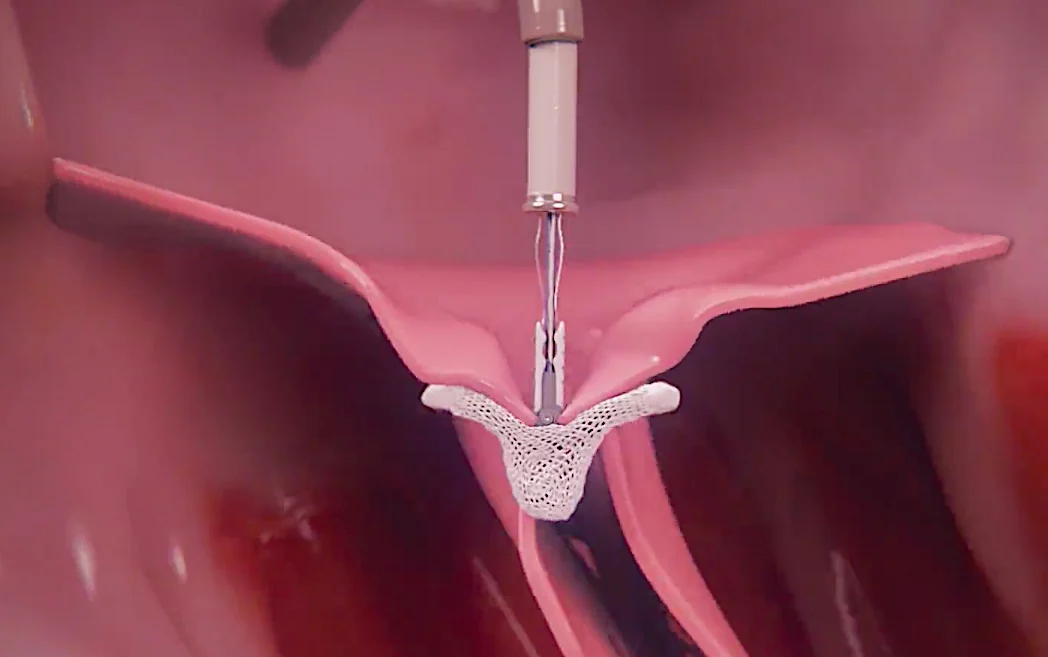
MitraClip is based on a surgical technique that stitches together the middle of the two valve leaflets. Here there is no stitching: a fabric-covered metal clip grips the edges of both leaflets and holds them together. The valve then opens through two orifices instead of one, and the leak decreases.
The clip reaches the heart through a vein in the groin, then crosses from the right to the left atrium through a small puncture in the wall between them. Until it is released, it can be repositioned. The heart keeps beating, with no heart-lung machine.
The technique is also called transcatheter edge-to-edge repair (TEER). Other clips of the same type exist, such as the PASCAL system.
MitraClip or surgery: the differences
| Criterion | Mitral valve surgery | MitraClip |
|---|---|---|
| Access | Chest opened (or small incision), heart stopped on a heart-lung machine | Through a vein in the groin, beating heart |
| Anaesthesia | General | General, with ultrasound through the oesophagus |
| Leak correction | Most complete and durable, especially for a damaged valve | Reduces the leak, sometimes incompletely |
| Recovery | Longer | Usually faster |
| Main candidates | Operable patients, especially with primary regurgitation | High-surgical-risk patients, some heart failure patients |
| Combined procedures | Bypass or another valve possible at the same time | No |
This table shows general trends, not rules: every case is assessed individually.
Which patients?
Primary regurgitation: mainly when surgery is too risky
The 2025 European guidelines (ESC/EACTS) encourage early surgical repair in low-risk patients. In symptomatic patients at high surgical risk, the recommendation for catheter repair has been strengthened: it should be considered.
Secondary regurgitation: a new role in some heart failure patients
This is the big change of 2025. In patients with heart failure, severe symptomatic secondary regurgitation of ventricular origin and reduced heart function (ejection fraction below 50%), catheter repair is now recommended at the highest level when specific criteria are met, to reduce hospitalisations and improve quality of life. These patients must first receive optimal medication.
An essential condition: anatomy
An ultrasound through the oesophagus checks whether the valve's shape allows a clip. A heavily calcified or small valve, or certain lesions, can make the technique impossible or less effective.
What the studies show
The landmark study is COAPT, conducted in the United States and Canada in 614 heart failure patients (average age 72) with secondary mitral regurgitation who remained symptomatic despite treatment. Over five years, adding MitraClip to medical treatment reduced heart failure hospitalisations by 47% and deaths by about 30%.
The results also have limits. Even with the clip, a large majority of patients died or were hospitalised for heart failure within five years (73.6% vs 91.5% without the clip), a reminder that the clip does not cure the heart muscle disease. The French MITRA-FR trial, in a different group of patients, did not find such a clear benefit, which is why patient selection matters so much.
MitraClip helps most in well-selected patients: a large leak relative to ventricle size, medication already optimised, suitable anatomy. Hence the value of an opinion from an experienced centre.
How the procedure goes
- Assessment: standard echocardiogram then ultrasound through the oesophagus, often a coronary angiogram and blood tests, overall health check.
- Heart Team meeting: interventional cardiologist, imaging cardiologist, cardiac surgeon and anaesthetist confirm the indication.
- Procedure: under general anaesthesia, usually one to two hours, guided by X-ray and oesophageal ultrasound. One or more clips may be placed.
- Monitoring: one night of close monitoring, then a few days in hospital with a follow-up echocardiogram.
- Follow-up: continued heart failure treatment, a check at one month, then regular cardiology follow-up.
The exact length of stay depends on your condition and is set by the medical team.
Want an opinion on your mitral valve?
Send your echocardiogram report and recent tests: an Evitalink adviser passes them on to a partner cardiologist.
📋 Request my free opinion 💬 WhatsAppRisks to know about
MitraClip is less demanding than open-heart surgery, but no procedure is risk-free. Possible complications include:
- bleeding or a problem at the groin access site (major vascular complications in about 1–4% of cases depending on the study)
- blood collecting around the heart, usually drained immediately
- partial detachment of the clip or a valve tear, which may require another procedure
- a leak that partly persists, or a valve that becomes slightly too narrow
- stroke or death, both rare
Ask the team for your personal risk estimate, and which options would remain if the clip were not enough.
MitraClip in Morocco
Morocco's first MitraClip mitral repair was performed on 20 September 2026 in a private hospital in Casablanca. The device's introduction was announced on 8 October by its distributor, SOMA Médical.
After TAVI since 2013 and the first tricuspid valve procedure in 2025, this confirms the progress of interventional cardiology in Morocco. Team experience is still recent, though: feel free to ask how many procedures have been done and how follow-up is organised.
Cost mainly depends on the device, the number of clips, the length of stay and tests. No public price is available: it is set out in an individual quote.
What about France and Europe?
In France, MitraClip has been reimbursed by the national health insurance since late 2016 for degenerative regurgitation in high-surgical-risk patients, and since 2019 for some secondary regurgitation with precise ultrasound criteria: patients with a very enlarged ventricle and only moderate regurgitation are not eligible. It is performed in authorised centres. Coverage and waiting times vary in other European countries.
If you live in Europe, the first step is to ask your cardiologist whether the indication applies and what the waiting time is locally. An opinion in Morocco can be useful as a second view, for people of Moroccan origin who want treatment near family, or for patients without coverage.
Questions to ask the team
- Is my regurgitation primary or secondary, and how severe is it?
- Why a clip rather than surgery in my case?
- Is my anatomy suitable according to the oesophageal ultrasound?
- Is my medication already optimised?
- How many procedures has your team performed?
- What options remain if the result is not enough?
- Who will handle my follow-up when I get home?
Get an opinion with Evitalink
Evitalink can send your file (echocardiogram reports, angiogram, letters from your cardiologist) to a partner cardiologist for an opinion. If treatment in Morocco is chosen, we organise a supported stay: accommodation near the facility, transfers, an interpreter if needed, and coordination with your usual cardiologist.
Sudden breathlessness or breathlessness at rest, chest pain, fainting or loss of consciousness: call your local emergency number immediately (112 in Europe, 999 in the UK, 15 in Morocco). A remote opinion must never delay urgent care.
Myths and facts
| Myth | Fact |
|---|---|
| MitraClip replaces surgery for everyone. | For operable patients with a damaged valve, surgery remains the reference. The clip is mainly for high-risk patients and some heart failure patients. |
| No chest opening means no risk. | Less invasive does not mean risk-free: bleeding, fluid around the heart or clip detachment remain possible. |
| After the clip, no more medication. | In secondary regurgitation, heart failure treatment must continue: the clip does not treat the heart muscle. |
| Every valve can take a clip. | The anatomy must be suitable, which the oesophageal ultrasound shows. |
Short glossary
- Mitral regurgitation
- Incomplete closure of the mitral valve, letting blood flow back into the left atrium.
- Primary / secondary regurgitation
- Primary: the valve is damaged. Secondary: the valve is normal but the ventricle is enlarged or weakened.
- TEER
- Transcatheter edge-to-edge repair, of which MitraClip is the best-known device.
- Oesophageal ultrasound (TOE)
- An ultrasound taken with a probe in the oesophagus, very precise for examining the mitral valve.
- Ejection fraction
- The share of blood pumped out by the left ventricle with each beat; it measures how strong the heart is.
- Heart Team
- A multidisciplinary team (cardiologists, surgeon, anaesthetist) that decides on the best option.
Further reading
Planning care in Morocco? Browse our latest health news or send us your file for a free opinion. This article is also available in French.
Your questions about MitraClip
Is MitraClip available in Morocco?
Does MitraClip replace mitral valve surgery?
How long does a MitraClip procedure take?
How long is the hospital stay after MitraClip?
What are the risks of MitraClip?
Is MitraClip covered in France and Europe?
Can I travel with severe mitral regurgitation?
Want a personalised opinion before deciding?
Send your file: an Evitalink adviser replies with a partner cardiologist's opinion and a detailed, free, no-obligation quote.
Sources
- Mitral valve: first catheter repair in Morocco (October 2026) — TelQuel
- 2025 valvular heart disease guidelines — European Society of Cardiology
- COAPT trial, 5-year results — PCR Online
- MITRACLIP G5, reimbursed indications — French National Authority for Health (HAS)
- Complications following MitraClip implantation — Current Cardiology Reports
This article is for information only and does not replace medical advice. Prices and protocols are confirmed in your personalised quote. Contact: +212 674 577 557 / +33 752 965 568.