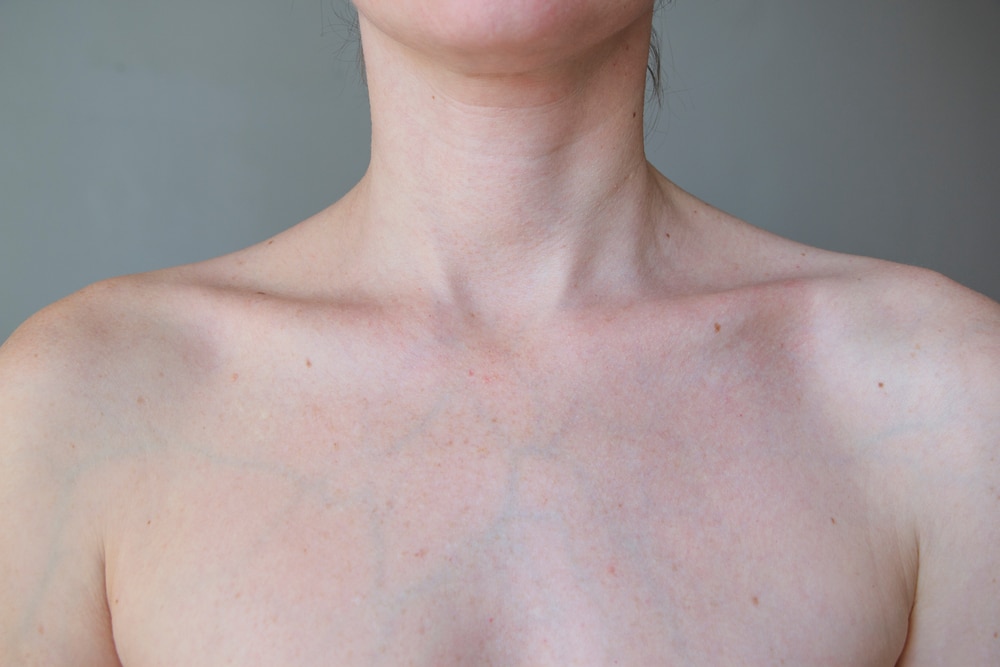
Noticed a blue or green vein showing through the skin on your chest or décolletage? In the vast majority of cases, this is a benign phenomenon linked to thin skin, pregnancy, breastfeeding, or weight loss. This guide explains the causes, the warning signs to know, and the cosmetic solutions available.
🫀 Why does a vein become visible on the chest?
The chest and décolletage are covered by particularly thin skin, especially compared to the legs or back. When the subcutaneous fat layer decreases or the skin thins, the superficial venous network — which carries blood back to the heart — becomes more visible. This area is also heavily exposed to the sun, which accelerates skin thinning over the years.
In women, breast tissue is also crossed by a dense venous network that naturally dilates with major hormonal changes: puberty, pregnancy, and breastfeeding.
🔍 The 8 main causes
- 1Thin, fair skin (genetics)Some people naturally have thinner, more translucent chest skin, making the venous network visible from a young age, with no associated condition.
- 2PregnancyBlood volume increases by 40 to 50% and the breasts prepare for lactation, dilating the superficial venous network of the breast and décolletage.
- 3BreastfeedingBreast engorgement during breastfeeding temporarily increases the visibility of superficial breast veins.
- 4Weight lossSignificant weight loss reduces chest fat tissue, making the underlying venous network more visible.
- 5Skin agingThe gradual loss of collagen and elasticity thins décolletage skin, especially after age 45-50.
- 6Repeated sun exposureThe décolletage is one of the most sun-exposed areas of the body. Cumulative sun damage accelerates skin thinning and venous visibility.
- 7Heat and vasodilationAs elsewhere on the body, heat dilates superficial veins, temporarily making their pattern more visible.
- 8Intense chest trainingIn athletes with low body fat, well-developed pectoral muscles can make the superficial venous network more prominent.
⚖️ Normal vein or warning sign?
| Feature | Benign vein | Warning sign |
|---|---|---|
| Onset | Gradual, long-standing | Sudden, recent (days/weeks) |
| Pain | None | Tender cord on palpation |
| Surrounding skin | Normal | Red, warm, retracted, or dimpled |
| Nipple | Normal | New retraction or discharge |
| Associated lump | None | Palpable lump or thickening present |
| Evolution | Stable | Rapidly growing |
🚨 When to see a doctor urgently
A vein that has become hard, tender, and cord-like (possible Mondor's disease); sudden onset after recent trauma or breast surgery; redness, warmth, or dimpled skin around the vein; new nipple retraction or unusual discharge; a palpable lump associated with the vein; rapid swelling of one breast. Most of these situations correspond to Mondor's disease, a benign superficial thrombophlebitis. But a medical evaluation (and, if needed, a mammogram or ultrasound) is the only way to rule out other causes and should never be delayed.
🤰 Pregnancy, breastfeeding, and chest veins
The increase in blood volume and hormonal changes of pregnancy naturally dilate the breast's venous network. This is entirely physiological and generally fades several months after delivery and the end of breastfeeding. No treatment is needed during this period unless a warning sign is present.
📉 What about after weight loss?
After significant weight loss — whether from dieting, intense exercise, or bariatric surgery — the reduction of subcutaneous chest fat makes the venous network more visible. This is purely cosmetic and carries no risk; it can still be corrected if desired.
💉 Available cosmetic solutions
Once any underlying condition has been ruled out and the vein remains cosmetically bothersome, two minimally invasive techniques are offered by Evitalink's partner clinics in Morocco:
- 1SclerotherapyA sclerosing agent injected directly into the superficial vein closes it gradually over a few weeks. Quick, outpatient technique, particularly suited to isolated décolletage veins.
- 2Vascular laserSuited to fine superficial chest veins. Laser light selectively closes the vein, with no needle or incision.
At Evitalink's partner clinics, a breast examination always precedes any cosmetic treatment of a chest vein, with referral for imaging if there is the slightest doubt. Once the situation is confirmed benign, the cosmetic treatment is planned.
❓ Frequently asked questions
✅ Key takeaways
A visible chest vein is, in the vast majority of cases, a benign phenomenon linked to thin skin, pregnancy, or weight loss. The right approach is simple: monitor its evolution and see a doctor promptly if there's pain, redness, a lump, or nipple retraction. Once confirmed benign, a cosmetic correction can be considered if it bothers you.
Have a question about a visible vein?
Evitalink connects you with specialists (aesthetic medicine, breast care) in Morocco for a reliable opinion and, if needed, suitable treatment.
Request a free quote → 💬 WhatsApp +212 6 74 57 75 57This article is for information only and does not replace medical advice. If you notice a warning sign (redness, a lump, nipple retraction), see a doctor without delay.
Sources and references:
• French Society of Breast Disease (SFSPM)
• French Society of Vascular Medicine (SFMV) — Mondor's disease
• Evitalink.com — Cosmetic surgery, Varicose veins
This article is for informational and preventive purposes. It does not constitute individualized medical advice.